
Understanding the Egg Donation Process: A Step-by-Step Guide
Donor egg IVF is a fertility treatment where the eggs from a donor are fertilized with the sperm of a partner (or sperm donor) and transferred back into the intended mother’s (or surrogate’s) uterus to achieve a pregnancy. The use of donor eggs in IVF has become increasingly common, accounting for nearly one in ten ART cycles in the United States. Comparable statistics aren’t available across much of Asia, where donor egg IVF is often restricted or unavailable, which is why many Asian intended parents travel for treatment.
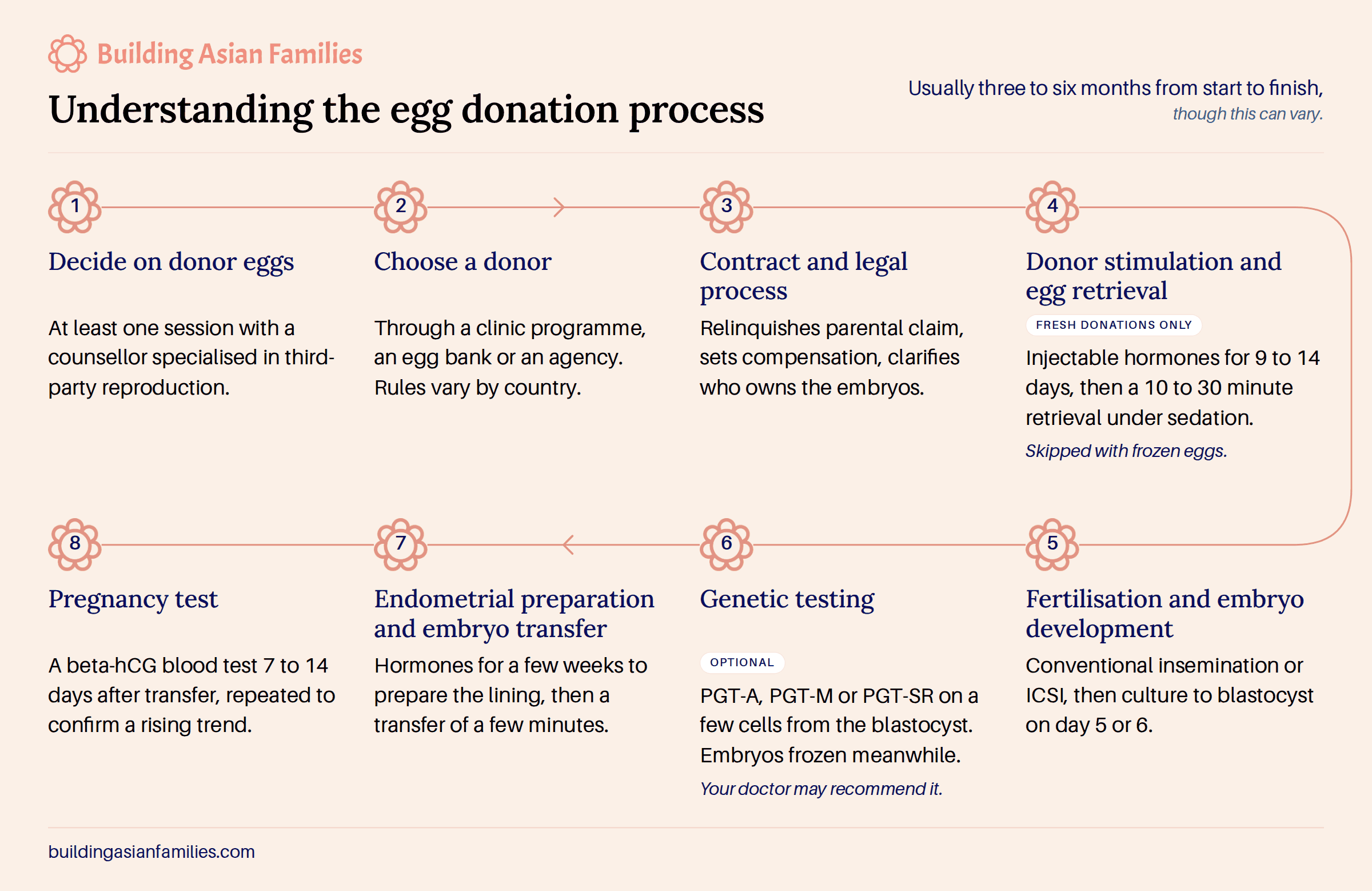
If your doctor has recently recommended donor egg IVF as a potential treatment for you, you probably have a lot of questions about the process. We’ve broken it down into the main steps you’ll need to take for your treatment. Usually, these steps take three to six months from start to finish, though this can vary.
1. Decide on donor eggs
The first thing you’ll need to do is to take some time to learn and reflect on what it will mean to build your family with donor eggs. The decision to use donor eggs often comes after a period of grief for those mourning the loss of not being able to use their own eggs. The process can feel overwhelming as parents navigate through the multitude of decisions and preparations required for this path to parenthood.
You – and your spouse if you have one – will want to meet with a counselor who is specialized in third-party reproduction at least once, and probably more, to talk through this major decision. Counseling is always recommended and even mandatory in some countries before your clinic or doctor will allow you to move forward with a donor egg treatment. If you already have a clinic, ask them if they can recommend a list of counselors. Counselling should be non-judgmental about your family structure and cultural background. After counselling, you’ll be ready to move forward with your treatment.
2. Choose a donor
Next, you’ll need to find your donor. There are three main ways of matching: through your clinic’s own donor egg program, an egg bank, or a donor agency. Some countries, like the USA, offer all three options. In others, one option may be more prevalent; for example, in Taiwan, many clinics have their own fresh egg donation programs as well as in-house frozen egg banks.
When it comes to how your donor is selected, there is even more variation between countries. In the USA or Canada, for example, you will be able to choose your own donor from lists of profiles that may include photos, video, self-reported family history and personality information. In other countries, such as Spain or Taiwan, clinic matching teams will select your donor for you.
Your country of treatment may also dictate whether your donor is non-identified (anonymous), identified (open), or known to you. In some countries you choose; in others the law decides for you. For example, Spain and Taiwan permit anonymous donation only, while in the UK all donor-conceived people can request identifying information at 18.
No matter how you choose your donor, you’ll need to know how she has been screened to ensure that she is healthy and will be a good match for you and your partner. The first, non-negotiable step is medical screening, which is generally fairly consistent between countries. But there are still variations: some countries mandate a specific panel of health tests by law, while others leave it to each clinic. Donors should always go through medical screening to ensure that they are healthy and that there are no conditions that might pose a risk to the donor, to future genetic offspring, or the intended mother (or surrogate) who will carry the pregnancy.
Next is mental health screening, which varies greatly by country. In countries such as the USA, professional guidance calls for a psychological evaluation by a licensed mental health professional. This is not the same thing as the counselling session that explains what donation involves. Elsewhere, mental health history may simply be self-reported.
The final consideration is genetic screening, which is usually not required but might be recommended by your doctor. Genetic testing can check two things: first, whether the donor has normal chromosomes through a test called karyotyping; second to check which genetic conditions the donor may be a carrier for. If you will be using your partner’s sperm combined with donor eggs, you will want to carry out the same genetic carrier screening for your partner as well to check whether he and the donor are carriers for any similar conditions.
3. Contract and legal process
Once you’ve chosen your donor, you’ll need to have a legal agreement with your donor. The donor contract must relinquish any future parental claim, specify compensation or reimbursement, and clarify ownership of eggs and resulting embryos. The contract might also set expectations for future contact, such as the disclosure of any medical conditions that the donor experiences in the future that her genetic offspring should be informed of, or the disclosure of future genetic offspring who will be genetic siblings to your child. You may be referred to a lawyer by your clinic or agency. Make sure the lawyer is specialized and well experienced in third-party reproduction specifically.
4. Donor stimulation and egg retrieval at your clinic (for fresh donations)
If you match with a donor who will undergo a fresh egg retrieval, the next step will be to schedule the egg donation with your clinic. Once you agree on the month that she will provide the donation, you’ll wait until the donor gets her period. Then, she will take injectable hormones to stimulate the growth of multiple follicles – and therefore develop multiple eggs – rather than the single egg of a natural ovulation cycle. Stimulation typically runs 9 to 14 days, varying by woman, doctor and protocol, with monitoring by ultrasound and blood tests.
After stimulation, she’s ready for the egg retrieval. This outpatient procedure is called follicular aspiration and involves removing the eggs from the follicles while the donor is sedated. It typically only takes 10–30 minutes, though it depends on the number of eggs being retrieved. If you opt for frozen donor eggs, you can skip this step.
5. Fertilisation and embryo development in the IVF lab
Whether fresh or frozen, your eggs will now need to be fertilized. Sperm must be ready on retrieval day: the intended father can either provide sperm that day, or you can use frozen sperm (partner’s or donor’s).
There are two fertilisation methods: conventional insemination (eggs surrounded by sperm in a dish) or ICSI (a single sperm injected into each egg). Frozen donor eggs are thawed then usually fertilised by ICSI, while fresh donor eggs could use either method. Consult your doctor to determine which is best for you.
Following fertilization, embryos are cultured to a stage called blastocyst (roughly 100–200 cells), typically on day 5 or sometimes day 6. It is normal for your clinic to give you updates throughout the culturing process on how each embryo is developing. All embryos that develop will be graded on morphology and developmental stage. Keep in mind that not all eggs fertilise and not all fertilised eggs reach blastocyst, so you’ll end up with fewer blastocysts than you had eggs. As a rough guide, expect around 80% of eggs fertilize and about half of those to reach blastocyst stage.
6. Genetic testing (optional)
This step is optional. Your doctor may recommend that your resulting embryos go through genetic testing before being used in IVF. To do this, a biopsy of a few cells will be taken from the blastocyst. There are three types of genetic testing:
· PGT-A checks whether the embryos have the right number of chromosomes. This is the most common type of genetic testing. Embryos without the right number of chromosomes are unlikely to result in an ongoing pregnancy, so this test can reduce miscarriage risk. PGT-A is widely used when the egg provider is over 35. As most egg donors are younger than this, the American Society for Reproductive Medicine’s 2024 guidance concludes that “the totality of evidence argues against the routine use of PGT-A in donor egg cycles.”
· PGT-M tests embryos for one specific inherited condition. It is used when carrier screening shows that the donor and the sperm provider carry the same recessive condition, so that only unaffected embryos are transferred.
· PGT-SR checks for structural rearrangements among chromosomes in the embryo. This is usually performed on the advice of a genetic counselor when one genetic parent has a finding on their karyotyping. The test will help to identify any embryos that have similar rearrangements.
In all cases, embryos are frozen while results are pending. The availability and legality of these tests vary by country; for example, these tests are widely available in the USA, Canada and Spain; others permit it only for specific medical indications. Some destinations restrict PGT-tested or sex-known embryos on import, so check this if you plan to export embryos to another country for treatment.
7. Endometrial preparation and embryo transfer
Finally, you’re ready to transfer the embryos into your (or your surrogate’s) uterus to try to achieve a pregnancy. This will be performed by your fertility clinic. Your clinic will prescribe hormones for a few weeks, with monitoring, to prepare your uterine lining. The transfer itself is an outpatient procedure that takes a few minutes and usually needs no anaesthesia.
8. Pregnancy test
The final step is confirming your pregnancy. You will do this through a beta-hCG blood test 7–14 days after transfer. If the test is positive, it will be repeated every few days to confirm a rising trend. A single positive result isn’t a confirmed pregnancy on its own. Levels that are low or stop rising usually indicate a very early miscarriage. If you become pregnant, you’ll continue to receive care from your fertility team until you are referred to an OBGYN for prenatal care. If the IVF cycle is unsuccessful, you’ll discuss the next steps with your fertility specialist.
At Building Asian Families, we exist to provide independent information on egg donation and surrogacy for Asian families so that you can make the best decision for your family. As intended parents, it took us months to learn where we could be treated legally, which clinics were high quality, and how to match safely. We want to give you the information to make decisions confidently and quickly, so that you can move on to building the family of your dreams. If you have more questions about donor egg IVF that we haven’t covered yet, please reach out to us. We’d love to hear from you!
